

AI in Oman’s Economy: A Concrete Look at What Changes Next.
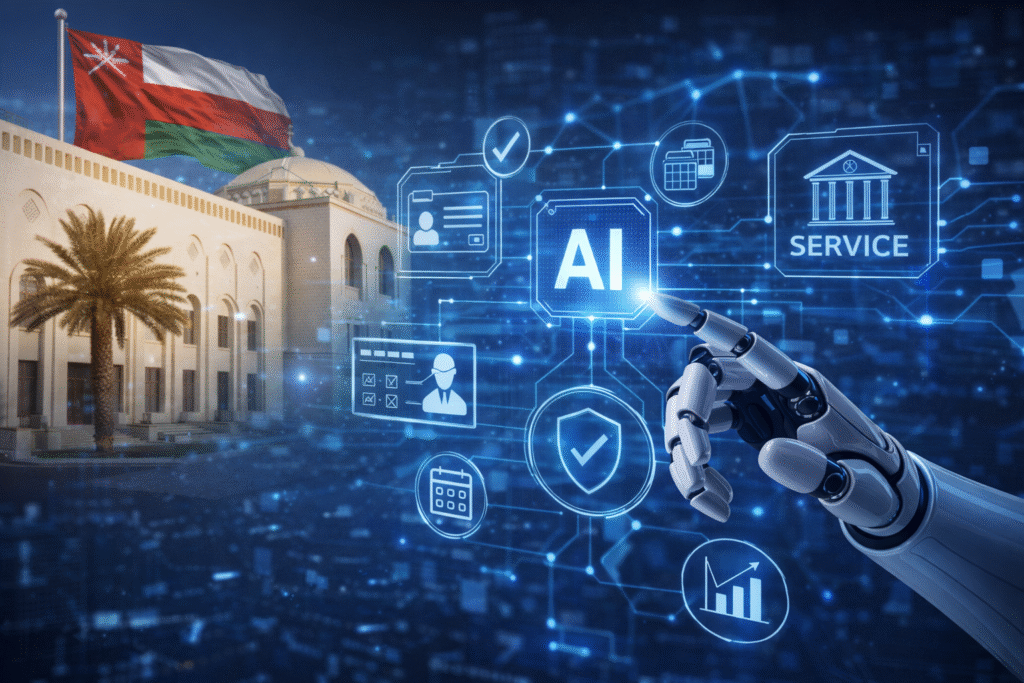
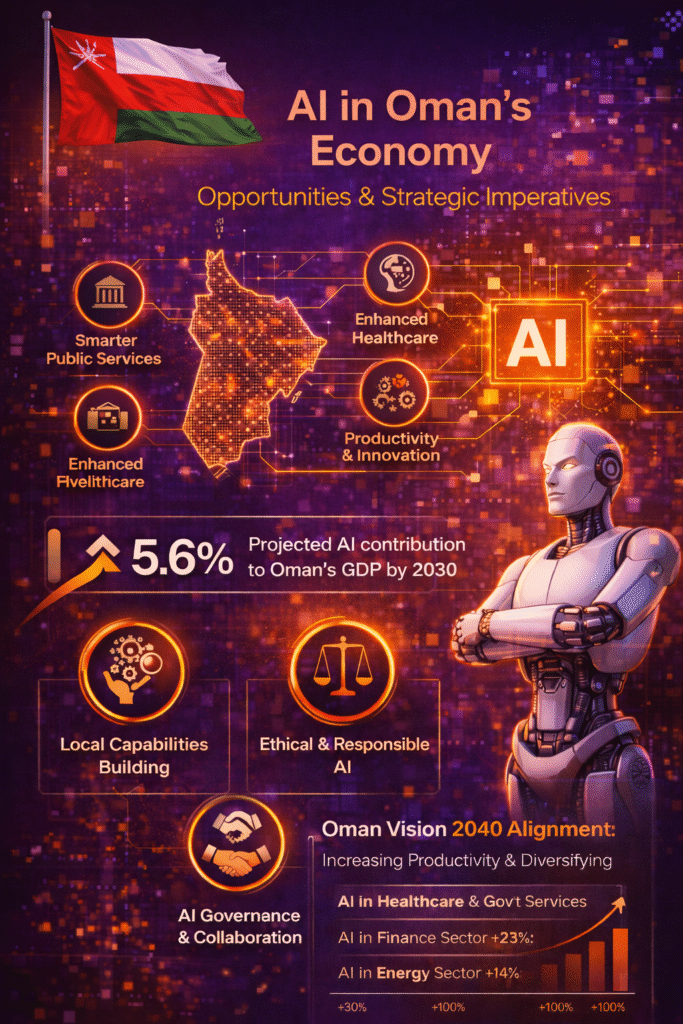
Artificial Intelligence is moving from “nice-to-have” to “national infrastructure.” For Oman, the real value of AI is not only automation—it’s productivity, better public services, smarter industry, and a stronger non-oil economy. Oman’s Ministry of Transport, Communications and Information Technology (MTCIT) frames this clearly: AI adoption is tied to economic diversification, upgrading productive sectors, and improving services for citizens and investors—while keeping AI governance human-centered and safe.
Below is a grounded, Oman-relevant view of where AI will realistically create impact, what must be built first, and how to reduce risk.
1) What Oman is already targeting
Oman’s national direction (through MTCIT) focuses on:
AI adoption across developmental sectors like education, healthcare, security, and social services
Integrating smart technologies into productive sectors to support diversification
Localizing AI capabilities (skills, infrastructure, R&D, partnerships)
Ethical governance: privacy, responsible data use, trustworthy algorithms, updated regulation
This matters because it defines the winning projects: they will be the ones that improve service quality, reduce operational cost, and raise productivity—especially in targeted sectors.

2) Economic impact: the “digital economy contribution” KPI
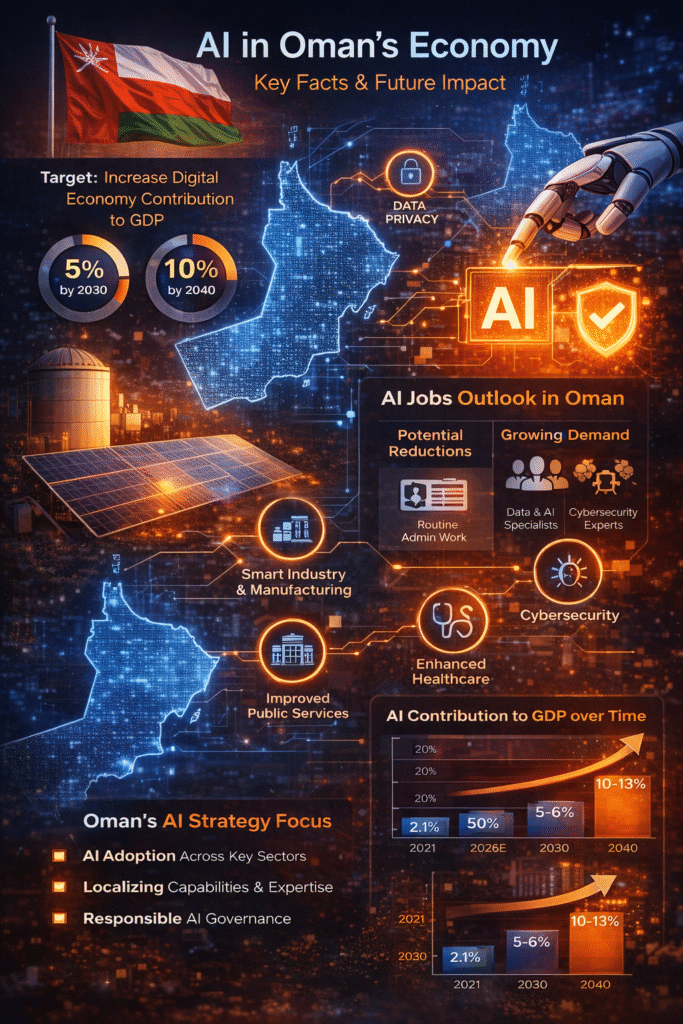
A key national KPI frequently referenced in Oman’s AI program narrative is increasing the digital economy’s contribution to GDP over time. Oxford Business Group reports targets to raise the digital economy’s GDP contribution from ~2% (2021) to 5% by 2030 and 10% by 2040, linked to the 2024–2026 AI programme direction.
So AI is not “only tech.” It’s a measurable economic lever: more output per worker, faster services, stronger private sector productivity, and higher-value jobs.
3) Where AI will matter most in Oman (sector-by-sector)
A) Government services (speed + quality + trust)
AI can reduce processing time, improve decision support, and scale citizen services—especially through chatbots, automation, and data-driven service delivery. MTCIT explicitly prioritizes using AI to improve government service quality and apply AI in “essential services.”
What “good” looks like (KPIs):
-
Service turnaround time ↓
-
Cost per transaction ↓
-
First-contact resolution ↑
-
Citizen satisfaction ↑
B) Industry & manufacturing (smart factories)
MTCIT highlights supporting Omani factories (large/SME) in adopting AI aligned with industrial strategy.
Use cases: predictive maintenance, quality inspection (computer vision), demand forecasting, inventory optimization.
KPIs:
-
Downtime ↓
-
Defect rate ↓
-
Energy per unit produced ↓
4) Jobs: what grows, what shrinks, what must be reskilled
AI won’t “remove jobs” in one event. It re-shapes tasks:
Routine admin work declines (data entry, basic reporting).
Demand rises for: data analysts, AI product owners, cybersecurity, process redesign, cloud engineers, and AI governance roles.
MTCIT also emphasizes updating education and research to meet AI requirements and building national competencies linked to labor market needs.
Practical workforce move: every organization should define 10–20 “AI-augmented roles” and retrain them first (finance, HR, customer service, procurement, operations).
5) The risks Oman must manage (and how to reduce them)
MTCIT is explicit about ethical, fair, safe AI, privacy protections, and governance foundations.
In practice, the biggest risks are:
-
Data privacy & compliance risk
-
Fix: data classification + access control + retention policies.
-
-
Bias and poor decision outcomes (especially in public services)
-
Fix: human-in-the-loop, model monitoring, documented decision rules.
-
-
Cybersecurity (AI expands attack surface)
-
Fix: MFA everywhere, secure APIs, logging, vendor review.
-
-
Low adoption (teams ignore the tools)
-
Fix: redesign workflows, train users, tie usage to performance KPIs.
-
6) A realistic roadmap Oman companies can execute
Phase 1: Foundations (30–60 days)
-
Build a clean data inventory (what you have, where it is, who owns it)
-
Select 2 high-impact use cases (one cost reduction, one service improvement)
-
Establish AI governance: privacy, approval process, vendor checklist
Phase 2: Pilot + measurable ROI (60–120 days)
-
Deploy pilots with clear KPIs (time saved, errors reduced, revenue uplift)
-
Train the “first 20 users” deeply
-
Create a simple dashboard to track adoption + performance
Phase 3: Scale (6–12 months)
-
Expand to 5–10 use cases
-
Integrate with ERP/CRM
-
Formalize an internal AI capability (product owner + data lead + security)
Conclusion
AI in Oman will be most valuable where it increases productivity, strengthens services, and supports diversification—while remaining safe, governed, and trusted. Oman’s direction already points to the winning combination: adopt AI in economic and developmental sectors, enable productive industries, localize capabilities, and govern responsibly.