

Artificial intelligence has moved from the laboratory to the boardroom. For Oman, it is no longer a question of whether to adopt AI, but how to do so in a way that diversifies the economy, raises productivity, and creates high-value jobs — all central goals of Oman Vision 2040.
A measurable economic opportunity
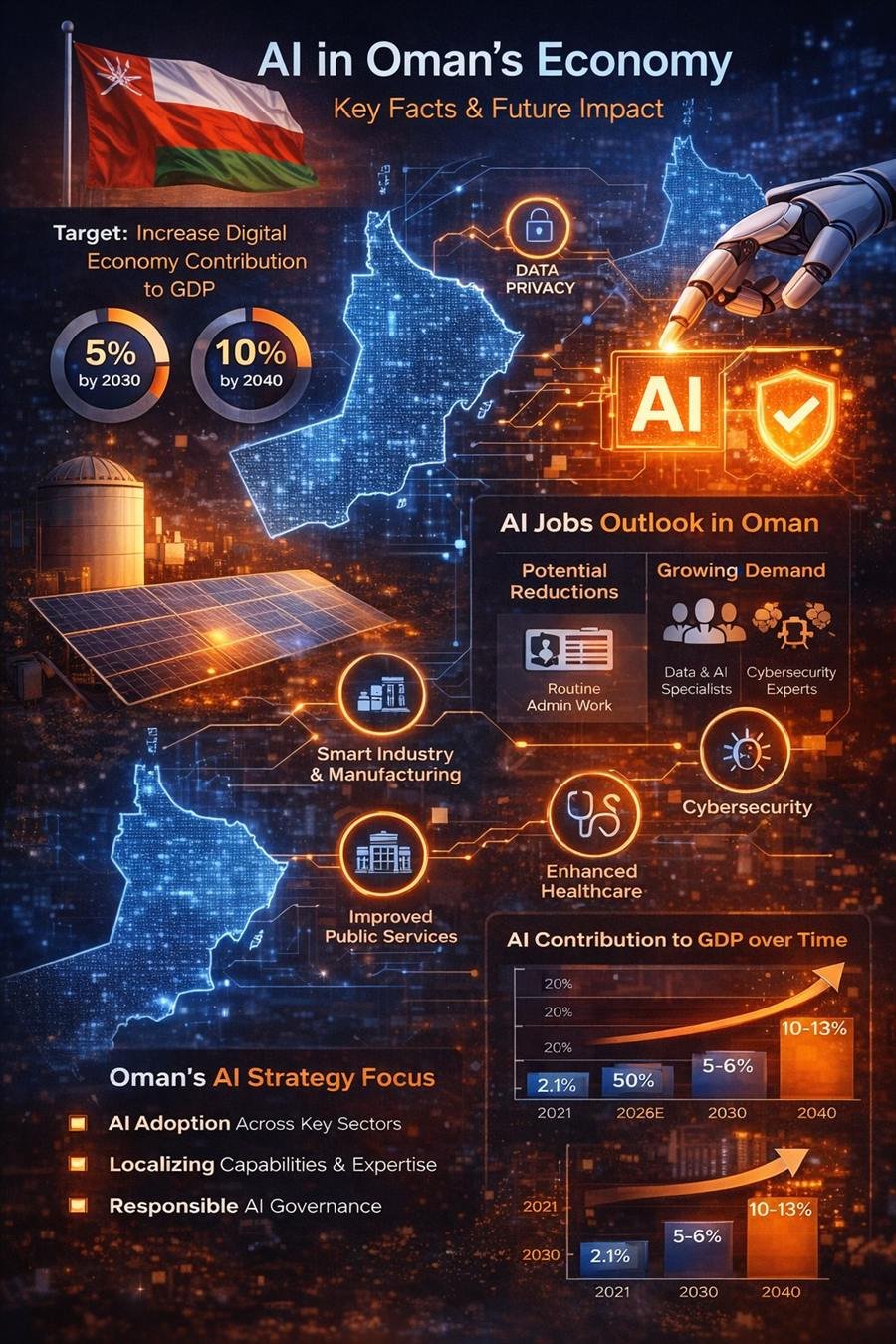
Oman has set a clear ambition to grow the digital economy's contribution to GDP — targeting roughly 5% by 2030 and 10% by 2040. AI is the engine behind much of that growth, with its own contribution to national output projected to climb toward the 10–13% range by 2040 as adoption deepens across sectors.
Where AI creates value
The impact is concentrated in a handful of sectors where Oman already has scale or strategic intent.
Energy & utilities
This is the clearest near-term win. AI enables load forecasting, anomaly detection, and smart utilities — cutting waste, predicting demand, and keeping critical infrastructure reliable as renewables are added to the grid.
Smart industry & manufacturing
Predictive maintenance, quality control, and supply-chain optimisation raise output and lower cost — reinforcing Oman's industrial diversification agenda.
Healthcare and public services
AI supports earlier diagnosis, better resource planning, and faster, more responsive government services for citizens and residents.
Cybersecurity
As digital dependence rises, AI becomes essential for detecting and responding to threats at machine speed — and a growing source of skilled employment.
What it means for jobs
The labour-market effect is two-sided. Some routine administrative work will be reduced as automation spreads. At the same time, demand rises sharply for data and AI specialists and cybersecurity experts. The net outcome depends on how quickly the workforce can re-skill.
The economies that benefit most from AI will be those that localise capability — building talent and governance at home rather than importing both.
Oman's strategy focus
Realising the upside while managing the risks rests on three priorities drawn from the national approach:
- AI adoption across key sectors — moving from pilots to production at scale.
- Localising capabilities & expertise — developing Omani talent and homegrown solutions.
- Responsible AI governance — clear rules on data privacy, ethics, and accountability.
Key takeaways
- Digital economy target: ~5% of GDP by 2030, ~10% by 2040.
- AI's own GDP contribution is projected toward 10–13% by 2040.
- Energy, manufacturing, healthcare, public services, and cybersecurity lead adoption.
- Jobs shift from routine admin toward data, AI, and security roles.
- Success depends on localised talent and responsible governance.
Conclusion
AI offers Oman a rare combination: a lever for economic diversification and a source of high-value employment. Capturing that value is less about technology than about choices — investing in skills, governing data responsibly, and scaling what works. The countries that make those choices early will set the pace for the region.