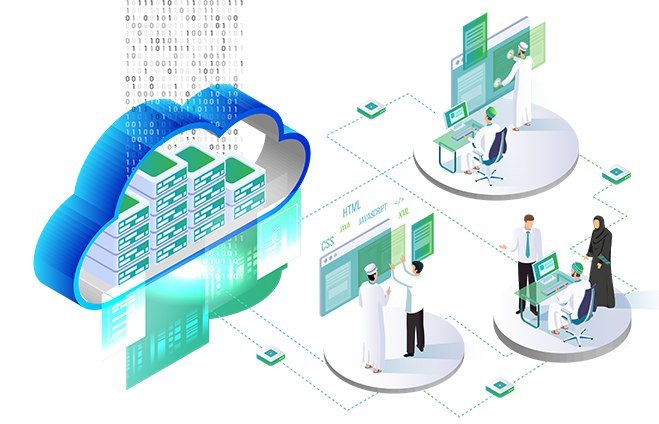
Cloud accounting (CA) is one of the most important technology trends in accounting and financial services. As Oman builds its digital economy under Vision 2040, moving accounting to the cloud across government bodies, companies, and banks promises greater accuracy and quality of work — and far easier access to financial information, processed and stored securely online.
What is cloud accounting?
Cloud accounting is software that can be used any time and from any location with an internet connection, without prior installation, maintenance, or dedicated servers. Instead of being tied to a single machine and paperwork, finance teams reach their data through a browser on any connected device — and can present the organisation's current financial position in real time.
Figures cited in the study (Gilbert, 2020).
Survey of accountants reported in the study (Ebenezer et al., 2014).
Why Oman is adopting cloud accounting
Oman has joined the global digital economy, and cloud accounting is one of its clearest practical applications. The government already runs a national cloud-based public-finance system — the "Maliyah" system at the Ministry of Finance — used for budget preparation, implementation, control, and reporting. It applies best practice in financial management to make optimal use of public resources in line with Oman Vision 2040, delivering accurate, integrated financial information to accountants and management on demand.
The benefits
Across the literature, the same advantages appear again and again:
Easy access
Reach the system anytime from any internet-connected device.
Lower cost
No costly hardware, software, or in-house upgrades and maintenance.
Time saving
Quick setup and automatic report generation free up the finance team.
Automatic updates
The provider updates the software continuously, with no manual effort.
Real-time information
A live picture of the financial position, available from anywhere.
Storage & auto-backup
Large, secure storage with automatic backups of all financial data.
Traditional vs. cloud accounting
The contrast with traditional, locally-installed accounting is sharp across every dimension:
| Traditional | Cloud | |
|---|---|---|
| Cost | High upfront cost — hardware, software, upgrades and maintenance. | Low initial investment; the provider handles upgrades and maintenance. |
| Flexibility | Less flexible; tied to specific machines and locations. | Accessible from any device and location with a secure connection. |
| Safety | More exposed to human error and local data loss. | Encryption, backups and provider security keep data safer. |
| Personalisation | Installed and tailored to the specific business. | Runs at scale, with less room for deep customisation. |
| Backup | Local only — papers and on-device files. | Easy automatic backup, restored from the cloud. |
Risks and challenges
Adoption is not without obstacles. The most cited are data security and integrity — a particular concern for government data — alongside dependence on a reliable internet connection, the threat of hackers, the effort of migrating data from legacy systems, resistance to changing established processes, and a shortage of staff skilled in both accounting and cloud technology. The study notes that, over time, these limitations are expected to ease as the technology matures and spreads.
Findings & recommendations
The research concludes that cloud accounting offers scalability, low operating cost, device and location independence, and a meaningful upgrade over traditional accounting information systems — while saving time and improving the quality of financial work. To capture that value in Oman, it recommends:
- Activating cloud accounting across government entities to simplify planning, financial operations, and reporting.
- Training programmes to raise the capability of finance staff on modern cloud tools.
- Applying international accounting standards (IFAC) when working in the cloud.
- Using strong servers and reliable connectivity to safeguard against technical failures.
- Encouraging SMEs to adopt cloud accounting given its low cost and room to grow.
Used well, cloud accounting broadens competition, lowers the cost of maintaining ageing systems, and supports the digital, knowledge-based economy envisioned by Oman Vision 2040.
Source: AlSulaimi, F. N., Al Maqbali, N. A., Al Hashami, M. S., & Mohammed Ahmed, M. B. (2024). Cloud Accounting and its Adoption in Sultanate of Oman. International Journal of Research and Innovation in Social Science (IJRISS), Vol. VIII, Issue IV. Oman College of Management and Technology. This article is an editorial summary of the published paper.